

Keywords
archive
decolonising
colonialism
photography
war
How to Cite




Abstract
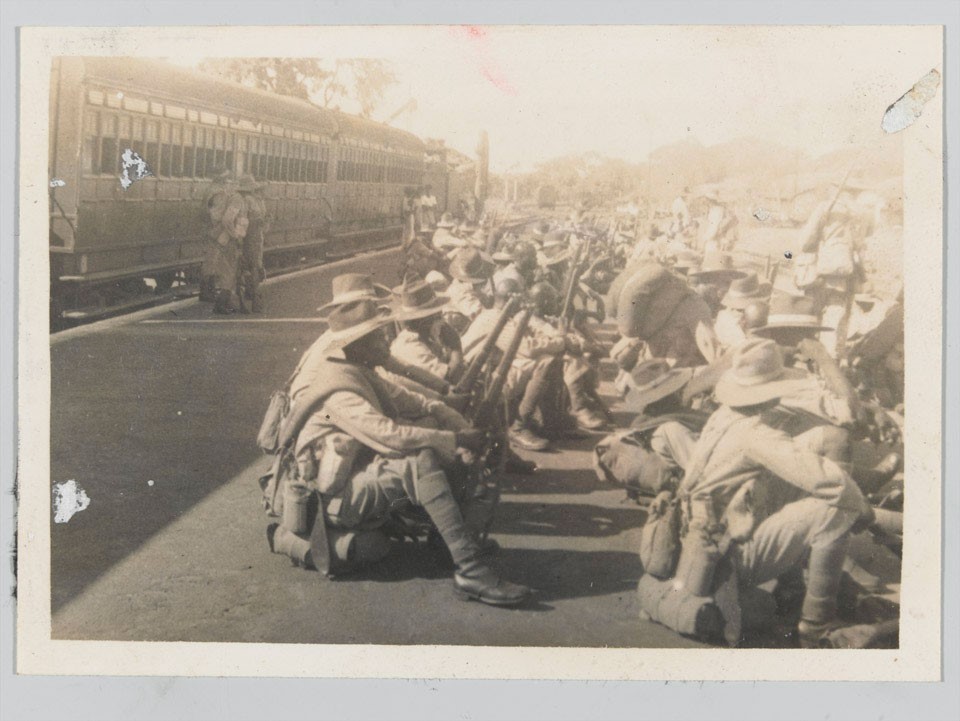
Visual culture has been shaped through the "Colonial lens", which continues to play a role in photographic practice. Historical conflict photography presents images of social upheaval and cultural interaction that demonstrate Colonialism and the Archive’s role in representing our cultural historical past. A re-reading of historical photographs through a contemporary understanding can re-address visual culture. The article focuses on the representation of British East African Soldiers in the Second World War, an underrepresented group in historical remembrance. Hundreds of thousands of Africans fought for the British in the War. Unofficial photographs taken by British Officers serving alongside Africans captured Africans’ forgotten role in the War. These photographs seen within the contemporary can initiate a discussion on the impact of the photographic past on the present. By readdressing these photographs and questioning the interactions contained within them, we can start to decolonise the photographic lens.
References
Azoulay, Ariella. 2008. The Civil Contract of Photography. Brooklyn: Zone books.
Campt, Tina. 2017. Listening to Images. Durham: Duke University Press.
Bishop, Cécile. 2018. “Photography, Race and Invisibility.” Photographies 11 (2-3): 193–213. https://doi.org/10.1080/17540763.2018.1457560.
Chapman, James. 1998. The British at War: Cinema, State and Propaganda 1939-1945. New York: I.B Tauris.
Halbwachs, Maurice. 1966. The Collective Memory, edited by Mary Douglas. New York: Harper & Row.
Halbwachs, Maurice. 1992. On Collective Memory, edited by Lewis Coser. Chicago: University of Chicago Press.
Hall, S. 1999. “Un‐settling ‘the heritage’, re‐imagining the post‐nationWhose heritage?” Third Text, 13 (49): 3–13. https://doi.org/10.1080/09528829908576818.
Hamilton, John. 2001. War Bush: 81 (West African) Division in Burma 1943-1945. Norwich: Michael Russell (Publishing) Ltd.
Killingray, David. 1983. “Soldiers, Ex-servicemen, and Politics in the Gold Coast, 1939–50.” The Journal of Modern African Studies 21 (3): 523–534.
Killingray, David. 2010. Fighting for Britain: African soldiers in the Second World War. Suffolk: James Currey.
Maguire, A. Marry. 2017. Colonial Encounters during the First World War:
The Experience of Troops from New Zealand, South Africa and the West Indies. King College London theses, Kings College London. Available at King College London E-Theses. https://kclpure.kcl.ac.uk/portal/en/studentTheses/colonial-encounters-during-the-first-world-war.
Mavlian, Shoair. (2014) 2015. “The Modern Archive of Conflict.” In: Conflict. Time. Photography, edited by Simon Baker and Shoair Mavlian, 207–217. London: Tate Publishing.
Murphy, Mahon. 2015. “Carrier Corps.” In: 1914-1918-online. International Encyclopedia of the First World War, edited by Ute Daniel, Peter Gatrell, Oliver Janz, Heather Jones, Jennifer Keene, Alan Kramer, and Bill Nasson. Berlin: Freie Universität Berlin.
https://encyclopedia.1914-1918-online.net/article/carrier_corps.
Sealy, Mark. 2016. Decolonizing the Camera: Photography in Racial Time. Durham
Theses, Durham University. Available at Durham E-Theses Online. http://etheses.dur.ac.uk/11794/.
Sealy, Mark. 2019. Decolonising the Camera, Photography in Racial Time. London: Lawrence and Wishart Limited.
© Membrana Institute and the author(s). All rights reserved.